Log Volume Measurement and Calculation in U.S. and Canadian Forestry
Accurate log volume measurement is critical for timber inventory, sales, transportation planning, and regulatory compliance in the forestry sectors of the US and Canada. Buyers and sellers rely on agreed log scaling methods to set fair prices: a seller can command full value only if volumes are correctly estimated, and a buyer must know how to scale logs to bid appropriately. Precise volume data also support forest inventories, tax reporting, road and truck loading calculations, and compliance with forest regulations. Modern field methods and digital tools help foresters ensure accurate volumes of roundwood are determined before harvest or at the mill.
Volume Calculation Methods
Board-foot scaling rules (US): In the US, logs are often scaled in board feet using historical log rules.
Doyle Rule:
where D = inside-bark small-end diameter in inches, and L = log length in feet. Doyle’s fixed 4-inch slab allowance causes it to under-scale small logs and over-scale large logs. It remains common, especially in the eastern and southern US.
Scribner Rule (Decimal C):
This algebraic form is used for logs under 28 inches in diameter. Scribner volumes increase erratically with diameter because board widths jump in integer inches. In the US, Scribner is widely used in the Lake States and the West, often with regional variations such as eastside and westside Scribner.
International 1/4" Rule:
This expression applies to a 4-foot section, with empirical adjustments added per 4-foot section up to 20 feet. The International 1/4-inch rule better accounts for taper and is generally considered more accurate, although it is less common in the US. In practice, the rule used is often determined by local tradition and contract terms.
Cubic-volume formulas (Canada): Canada and the US Forest Service increasingly use metric cubic volumes.
Smalian’s Formula:
where A1 and A2 are end cross-sectional areas in m², and L is length in meters. Smalian’s formula averages the two end areas, so it accounts for taper. It is widely used in Canada and by the USDA Forest Service.
Huber’s Formula:
This method uses the mid-diameter cross-sectional area. Huber’s method can be more accurate for logs with pronounced taper, but it requires a midpoint measurement. In practice, Smalian’s formula is often preferred because only the end diameters are needed.
In summary, board-foot rules such as Doyle, Scribner, and International estimate lumber yield, while Smalian and Huber provide geometric solid-wood volume in cubic meters. Conversion factors are sometimes used between these systems, but the results vary by log characteristics.
Measurement Units: Board Feet, Cubic Meters, Cords, and Tons
Board Feet (bf): A primary unit in the US. One board foot equals 1" × 12" × 12" of lumber. One MBF (thousand board feet) is common for scaling. For conversion, 1 bf ≈ 0.0023597 m³, so 1 MBF ≈ 2.36 m³. Equivalently, 1 m³ ≈ 423.8 bf.
Cubic Meters (m³): The standard metric unit used in Canada and Europe. Canadian scale manuals commonly report cubic volume outside bark.
Cord: A unit for stacked roundwood such as firewood and pulpwood. One cord is 128 ft³ of wood in a 4′ × 4′ × 8′ stack, equivalent to about 3.62 m³.
Tons (Weight): Logs may also be sold by weight. In the US, a short ton equals 2,000 lb, while Canada often uses the metric tonne of 1,000 kg. Weight-to-volume conversions depend on species, bark, and moisture content. Bark-on logs weigh more, and bark volume is later deducted when estimating lumber yield.
Standards and Regulations in Log Scaling
USA – National Forest Log Scaling Handbook (FSH 2409.11): The US Forest Service publishes official procedures for scaling National Forest timber, including how to measure, apply rules, and deduct defects.
USA – Regional Log Scaling Bureaus: Regional bodies publish official rules. One example is the Northwest Log Rules Advisory Group, which publishes the Westside or Westwood Scribner Rule used in many Pacific Northwest sales. Other regions may use local variants such as Pacific Coast or Inland Scribner rules.
Canada – Provincial Scaling Manuals: Each province has legislation and manuals governing timber scaling. British Columbia, for example, requires harvested timber to be scaled for volume and quality and publishes a Timber Scaling Manual covering volume calculation, bark deductions, and defect rules. Other provinces have similar manuals or coordinated standards.
Canada – Industry Standards and Technology Protocols: Research bodies and the forestry industry continue to develop log scanning and measurement technologies, but these must still align with the relevant provincial scaling manuals.
Together, these standards ensure that all parties use the same rules and conventions. In contracts, sellers and buyers should explicitly agree on the rule and unit to be used, such as Scribner scale, Doyle scale, or cubic metres outside bark.
Measurement Tools and Technology
- Diameter Tapes (D-tapes): Cloth or steel tapes calibrated so that circumference reading directly gives diameter in inches or centimeters.
- Tree Calipers: Rigid calipers for quickly measuring stem or log diameter.
- Biltmore Stick: A rough field tool for estimating board feet in logs or standing trees.
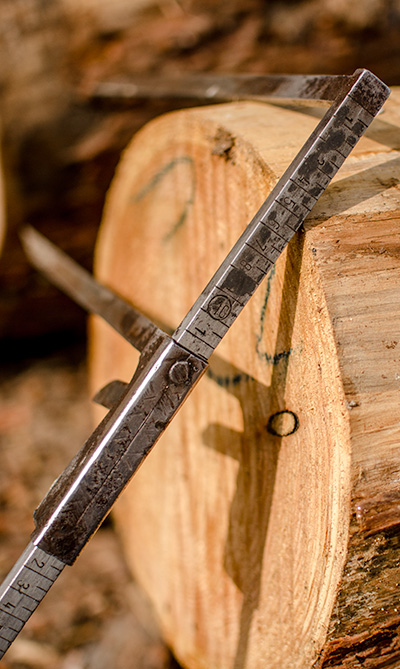
- Log Scale Sticks: Four-foot sticks marked for Doyle, International, and Scribner rules so that board-foot volume can be read directly.
- Measuring Tape: Used to measure log length in feet or meters.
- Electronic Devices: Digital calipers, scanners, and mobile tools can record diameters and lengths and compute volumes. In practical field work, dedicated apps such as Recorder can help record log and timber tallies, while WoodProfi can support photo-based wood volume estimation where suitable.
- Laser Scanners and LIDAR: Advanced systems used in mills and larger operations to capture log dimensions automatically.
- GPS and Mapping Tools: GPS-enabled tablets and survey tools help link measurements to stand and log location.
Field crews should also carry the applicable log scaling rule books and follow prescribed practices when using these tools.
For practical field use, Recorder is suitable for recording log and timber tallies, while WoodProfi is suitable where photo-based wood volume estimation is useful as part of the measurement workflow.
Practical Tips for Accurate Measurement
- Measure Small-End Diameter Inside Bark: Always measure the diameter at the log’s small end, inside the bark. If the cross-section is elliptical, take two measurements at right angles and average them.
- Follow Rounding Rules: Round diameters according to the applicable standard and use the same method consistently for the whole lot.
- Measure Log Length Correctly: Standard lengths are often in even-foot increments such as 8, 10, 12, 14, and 16 feet. Measure from one end face to the other and note non-standard lengths separately.
- Account for Bark: If diameter is measured outside bark, estimate bark thickness and subtract it according to the applicable rule or bark table.
- Watch for Irregularities:
- Double-heart logs: Special handling is required depending on whether the condition occurs at a fork or butt.
- Crook or Sweep: Measure length as though the log were straight, applying any allowed trim deduction under the rule in use.
- Taper: Board-foot rules generally ignore taper, while Smalian’s formula accounts for it.
- Avoid Common Field Mistakes: Do not measure diameter at the large end or mid-length unless the chosen method specifically requires it. Do not include stump in length. Check tape calibration regularly. When scaling logs in a pile, measure the nearest exposed ends correctly.
- Document Everything: Record log number, species, diameter, length, rule used, and any deductions for sweep or defects.
Careful, consistent measurement reduces disputes and produces defensible volume estimates.
Sample Log Volume Table
The table below gives example volumes for round logs of common sizes, calculated by the Scribner rule and converted to cubic meters.
| Diameter (inches) | Length (ft) | Volume (Scribner bf) | Volume (m³) |
| 8 | 8 | 16 | 0.08 |
| 8 | 16 | 32 | 0.16 |
| 12 | 8 | 40 | 0.18 |
| 12 | 16 | 79 | 0.36 |
| 16 | 8 | 80 | 0.32 |
| 16 | 16 | 159 | 0.63 |
These values are approximate. For example, a 16-foot log with a 12-inch small-end diameter scales to about 79 board feet under Scribner, which is roughly 0.36 m³ of solid wood. This comparison illustrates the difference between board-foot and cubic-meter reporting in US and Canadian practice.
For practical field use, Recorder is suitable for recording log and timber tallies, while WoodProfi is suitable where photo-based wood volume estimation is useful as part of the measurement workflow.